
24 Days in the Cook Islands: Lost in Paradise - Week 3 and more

Updated: Aug 10

Day 15 – Ootu Beach
Aitutaki atoll is made up of 15 islands (of which 14 are uninhabited), sandbars and other small almost islands. The triangular shaped lagoon is surrounded by a barrier reef, hence the water in the lagoon is very calm, shallow and low lying.
At dawn, just as the sun paints the sky with pink strokes, we take a long walk. The little community of Ootu Beach has one road that ends at a park where several catamarans and sunfish boats call home. On the road leading out, we pass the Kotu Café, a few local houses, and a Tou Moana Outrigger Canoe Club sign that tucks away from street. At the end of the road around a bend lies our Boatshed Restaurant with its drinks, gluten free French fries and spectacular view. And that’s it. We return to our place and swam, eat, and write beneath the palm trees and absorbing the lagoon and all its glory. A perfect day.

Travel can be easy or hard
I’d have to say traveling local style is always a bit of a challenge. As the song says, you pay your money and you take your chance especially when traveling on a budget. But that often tends to be the good part, the juicy stuff, the food for stories to share with fellow travelers over wine and laughter. Since there is very little written about the Cook Islands, we had to travel there to really figure it out. Here’s what we learned. On the one hand, Rarotonga is less expensive and more connected with better supplies, better markets and a bit more action although internet and air conditioning is hit or miss. On the other hand, on Rarotonga, there's more tourism and less areas untouched. Aitutaki is more expensive with limited access to internet, restaurants and accommodations. Still Aitutaki is a wonder to see and the Bishop’s Cruise to the reefs with the giant clams and to One Foot Island completes our fantasy checklist.

For 5 hours, we cruise the lagoon in a 45-foot double hull catamaran with 30 fellow passengers. The small crew serenades us with Māori music, singing and drumming, and a prayers for our safety. Our first stop is Yum Yum Island, a small spit of land who’s claim to fame is the filming of an episode of the Survivor Series.

With its white sand beaches, luscious greenery and coconut trees stock full, we could think of worse places to be stranded. Then off we go to snorkeling among colorful giant clams in water so clear it felt like an aquarium. The water is teaming with hundreds of fish swimming in reef schools: convict tangs, triggerfish, schools of sliver yellow jack fish, tiny purple florescent fish, Moorish idols, and yellow tang among others. But the giant clams are the most fascinating. With their 2 ventricles that filter rich plankton water and exposed colorful soft mantles, they measure 3 feet in length and weighted 100’s of pounds. The insides or belly of the clam ranged from purple to orange tiger striped and even a leopard skin pattern.

Each clam is unique. The colorful neon spots on the lip of their shells attracted small fish who swim in to take a bite. We watch as one such tiny fish takes a nibble on the dormant looking clam. The clam snaps closed quickly with the reflexes of a shark then returned to

its statue stance, motionless but fully alive. With a lifespan of over 100 years, these mollusks live so long that some have coral growing on their sides. Think Pirates of the Caribbean. The captain of our cruise tells us of a clam named Ming that lived 507 years. Impressive.

Then off to One Foot Island.

The crew recites the story of a father and son who broke a taboo when fishing in an area that was reserved for the king. When the kings guard spotted their fishing boat, the father and son raced to the island. The father instructed his son to step first in the soft sand while he stepped in the same foot prints creating only one set of tracks. The father hid the boy in a Pandanus tree while he traveled further inland attracting the guard’s attention. The guards killed the father for breaking the taboo but the son was saved. At the end of the story, the crew announced that the entire cruise ship’s company were descendants of the son. We eat a lunch of grilled tuna, local fruit, grilled breadfruit and salads. Then free to explore the island, we swim once again in the crystal-clear lagoon filled with schools of colorful fish and walk on a sand bar that crosses the small lagoon.

Day 16 - Another Sunday
On Sunday we ride the circumference of the island, stopping to watch the local women, and their flower laden straw hats, walking home from church. Just as in Rarotonga everything closes on Sundays. Instead, the people go to church and head home to spend the day with family. We hear the clanking of dishes and soft sound of laughter emanating from the open windows of the houses we passed.

Back at Ootu Beach, we kayaked along the shallow waters of the blue lagoon diving in water that was wet but barely cooling. We dine once again on Chef Nag’s fine food. The menu of NZ Rib Eye, local Chicken and Yellow Fin remains the same but we mixed it up. I have the Yellow Finn Tuna and Tim devours a perfectly Charred Half Chicken. We share a bottle of Chardonnay this time with three women from Australia woman who laugh at our various travel stories. During our card playing, I must have upsold at least 7 seats, the Australian women being among them. For that I receive a NU, cold coconut water served in the coconut complete with a straw.
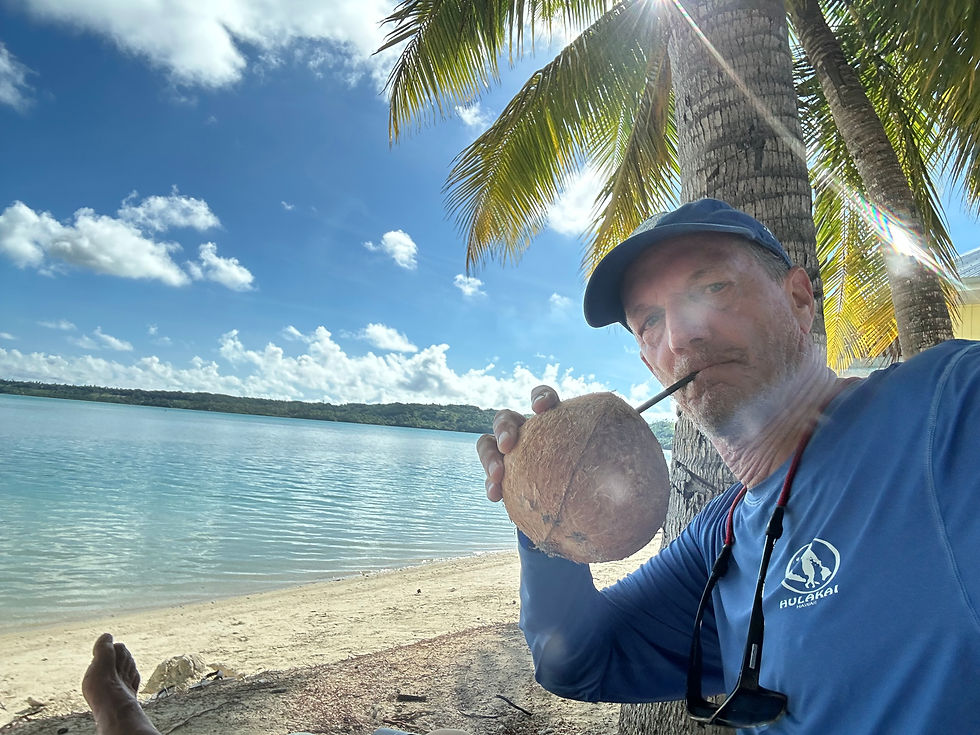
Later, we crack the shell and make an offering of the tender insides to the wandering chicks. But first the roosters take their share only because they demand it. After the chicks have their fill, a mina bird swoops in for a peck. Then a small orange hermit crab wearing a fancy conch shell polishes off most of the remains. Finally, the sugar ants make the shell shine. There is an efficient hierarchy in third world countries. Here it’s rooster, chicken, mina birds, hermit crab, sugar ants. Nothing goes to waste.

Day 17 - A Day of Rest
While traveling I often forget to slow down and rest. Tim gets annoyed that I want to be on-the-go most of the time. But traveling to new parts of the world energizes me, begging me to discover the culture and meet new people, especially the locals.
But after last night activities, today is clearly rest day. After a simple breakfast of fruit and tea, we spend time in our air-conditioned room reading and napping. The outside boils without a whisper of wind. We stay tucked away until 3pm when boredom turns us out to the Blue Lagoon to write and play a game of 15. That’s when the fun begins.
In front of the restaurant, a kayak pulls up and with three young Asian millennials returning to shore in a panic. The spokesmen (also named Robin), with dyed red hair, shouts to us in broken English.
“Lost our phone, help please,” he says and points to the center of the shallow lagoon.

That’s all it takes. Tim, the Super Hero dons on a suit with his snorkel gear in tow and rows out on a kayak to the rescue! After surface diving for 40 minutes in the 6 feet of water, he comes up empty. Nonetheless, the young men thinks he's the greatest and invites us to dinner.
Later that night, we meet at a mid-island restaurant called Avantea. It's packed with tourists, many of which we have seen at the resorts. The food is good and features a large menu of local produce. I choose a Rib Eye steak that's more rib than eye and after sharing stories with our new, young friends, we head out to out scooter in the balmy star filled night. The ride home is magical. The air is cool and the roads are empty. We travel from the south of the island to the very northern tip and around the peninsula to our home away from home passing a few buildings, all closed for the night. But mostly, we passed the open shoreline of the moonlit lagoon. Tomorrow, we'll leave this special place, the turquoise lagoon, our pop-up Blue Lagoon Restaurant and the polished, cool rooms of the AT Village. Heading back to Rarotonga for the last 5 days of our journey, we can't wait.

Day 18 – The Return to Rarotonga
The rental company picks up our scooter at the villa and we walk to the nearby Koru Restaurant for brunch. It's really too hot to eat but the food looks lovely and we aren't to reach our new accommodations at Avana’s Beachfront Apartments until 5 in the evening. Time to fuel up. We plan to take the local bus for the rest of our stay to be true to the budget idea. You can travel for $5 NZ/pp around the entire island, about $3.00 USD/pp.
Heading to the airport, our shuttle is once again driven by Robin, a woman who wears many hats. The tiny Aitutaki airport is empty with no salty sea captain staring us down. In fact, by the time the plane arrive, there were only 4 passengers for the return trip to Rarotonga. We all sit on the outside benches hoping for a crosswind. I buy an ice pop for $.60 just to put on my neck and dream of the air-conditioned plane ride home.
Instead, we're quickly shuttled into a puddle jumper with only a captain and a pilot in training. Gone is the stewardess who handed out the cool towels and the air conditioning is non-existent. We are only 4 after all. We sit fanning ourselves with the plastic evacuation cards.
It is a smooth ride for the most part until the landing. Our pilot in training is just that. We touch down once and rise up again. Weightlessly we hover over the tiny air strip until after a few more bumps we braked and came to an unsteady stop. The captain starts laughing and it's so infectious that all the passengers join in. We made it safely and that was the point. Just another day in the Cooks.

At the airport, we asks an auntie about how to catch the bus. “If you go anti-clockwise it comes here. Clockwise it’s across the street.” She pointed to a metal shed in the distance.
We grab our bags, once again from an unsupervised cart, and head for the shed which we're sure will house a schedule and a bit of shade maybe even a bench to sit on, only to find out it's a metal covering for an above ground grave. You have to understand, graves in the Cooks are naturally above ground like New Orleans due to the elevated water table. But instead of designated areas for the dearly departed, like a churchyard, they were everywhere. Stone mausoleums pop up next to grocery stores, along prime beach front, next to bus stops. And the locals honor their dead with all kinds of decorations from flowers, island planters, intricately woven leis and in some cases, like at the bus stop, a with blinking Christmas lights. I ask a local friend with as much humility I can muster, what’s the story with all graves. He speaks reverently about his father’s grave and how they often celebrate special occasions with a BBQ or party with the grave at its center. It's a way of remembering their love ones while inviting them for some banana wine.
Oops not the bus station after all and definitely no bench there. Instead, we move a bit further down the road to a shady spot ready to wave down the clockwise bus and learn the route.
No sooner have we stopped than a man on a motorcycle pulls up and greets us.
“Kia Orana,” he said. The bus is just 5 minutes behind you. He showed us his app that tracked local transit anywhere in the world. See you are here and that’s the bus,” he pointa out, spouting directions like a seasoned traveler.
We must look pathetic with our bags of rolling luggage and backpacks sticking to our sweating backs because before he can show us more, a car pulls up with two young local women inside. The driver lower her window. “Kia Orana”.
“Kia Orana.” we say.
“Where you going?”
“Muri Beach,” I say.
“Murdy?” the driver corrects me. For some reason there is a hidden “d” in the islanders’ pronunciation.
“Yes, Murdy,” I say.
“Hop in. We got stops to make but we’ll get you there.”
So much for the bus. We load our gear and climbed in the back seat. It's air-conditioned. So whatever the errands, we gladly go along for the ride.
The driver, Anahera and Marilee, the co-pilot, tell us their story in a light hearted manner. Anahera (Angel) a strong Māori woman, has been on Rarotonga her whole life while Marilee, her cousin, has recently returned from her work in New Zealand. Since New Zealand offers more vibrant employment opportunities, people from the Cooks often emigrate to New Zealand for work. This is a common story. At the same time, the Cook Islands need workers to run their tourist industry and welcome people from Tonga, Fiji, Samoa, and the Philippines.
“We saw you standing on the road and had to turn around twice to get you,” Anahera said. “We couldn’t leave you there.” Just another example of Cook Island hospitality. We are picked up and escorted by locals within 10 minutes of landing.
Our first stop is to Marilee’s 72-year-old auntie who lives off the main road a bit inland. We pass many well-maintained houses with meticulous lawns.
“Do you mow the grass in Hawaii?” Marilee asks.
“We mow some and give up the rest to the jungle,” Tim says.
“Come on they have workers do that,” Anahera says to her friend.
“No, we mow our own,” Tim says.
“Here, if you do not keep up your yard, a neighbor, auntie or uncle will come over and mow your yard already.”
We pull up at Marilee’s auntie’s house and drop off a large patterned, plywood board. “My auntie uses it to make batiked sheets to sell at the market,” she explains.
Then off towards “Murdy” only to pull up to a fruit stand making a quick stop for tomatoes.
“Tomatoes auntie?” “No more.”
Next, we pull into a Quick Stop store where our driver picks up what looked like fresh donut holes and a container of green mussels cured in vinegar. She offers it all around. I eat a mussel and Tim a donut hole.
“Where are you going again,” Anahera asks as if the island was the size of Maine.
“Avana’s Beachfront Apartments,”I said.
“You mean AvAna. AvA means place of the cave.”
“Here it is,” I point to the sign. We pull into the long driveway passed a big lazy, brown pig feasting on fallen coconuts, and banana and paw paw (papaya) orchards.
“That’s where you go to borrow some paw paw,” Anahera says with a laugh. “Hey I used to party at that house right there.”
A few more bumps and we arrive, thank our escorts while our beautiful hostess Desiree greets us. “Kia Orana,” she says pleasantly.
“Kia Orana,” we echo. While we are away, Desiree has upgraded us to a two-bedroom villa for the same price. Now, here was luxury we could afford. Our upstairs downstairs 1000 ft villa had a full kitchen complete with a dishwasher, stove top and full size frig, two bedrooms, ensuite bathroom and a beautiful lanai that faces the sea all for $205 NZ/nt, ($120 USD).

Everything is meticulously clean and well appointed. We can't believe our luck. It even has a small air conditioner in one of the bedrooms that you could rent for $10 NZ/nt ($6/nt USD). Eat that Matriki. I have to admit. Tim is right. Sometimes it pays to shop around and visit accommodations before renting. But again, not knowing where you’d rest your head for the night takes some courage.
That night, we meet our young Canadian friends at the Rickshaw Rarotonga Restaurant, an Asian restaurant on the small Muri Beach downtown strip. They have a sign out front that lists gluten free options. I'm in. It's delicious Asian food, some of the best food we eat on the island. Heavenly!

We start a table conversation about the weirdest people we have met on our travels. They trump us with a story about a trip to Cuba complete with a seaside bungalow, a romantic vacation for two. The first night at the bar however, they meet a 72-year-old Canadian man who tells them of his life as a nudist in Ottawa complete with pictures of his naked daughter-in-law. “But that wasn’t the best part,” Mike says. The old man regaled proudly that he and his wife were swingers and in fact he had written a book entitled Swing Your Partner. “Look it up,” Mike says. “It’s out there.” We start laughing hysterically and can't stop. Meeting people when traveling is my favorite part.
The Passage - Day 19

With only five days left, we decided to finish our snorkeling tour of Rarotonga. With some of the most protected waters on the planet, we wanted to spend as much time as we could in the exploring the sea around us. And with the constant heat, we naturally gravitate to the water. For the rest of our stay, we planned on watching marine life from the shore, snorkeling with pristine coral and fish and eating fish: ika mata, fresh tuna or succulent mahi mahi. Sorry fishies.
After a full night’s sleep, we wake at 6am and actually feel a bit chilly. Amazing what a little air conditioning can do. We grab our coffee and tea and head to the two Adirondack chairs that sit on a small grassy knoll facing the lagoon. Soon, clouds colored a fiery red, open up to a full sunrise, painting the water a spectrum of reds, yellows and golds. We sit and watched stingrays raise their tipped wings above the water in play. They move gracefully across the bay.

Rarotonga is surrounded by five major navigable passages that break through to the open ocean, a channel in the coral reef that ringed the island. These channels are well-known for their strong currents and abundant marine life. Ocean water flow in from narrow openings in the coral providing protected gateways connecting the open ocean to sheltered lagoons. The passages in the Cook Islands are packed with fish and marine life. They offer food, shelter and easy access to calm water for a vast variety of species. Like marine reserves, these vibrant hotspots thrive due to consistent reef health, and shifting marine life moving between the sea and shallow reefs. Avana Beachfront Apartments sits at the edge of the Avana Passage.

With a channel right in front of us and we're ready to explore. But today, neither one of us wants to move very fast. So instead, we eat our breakfast of paw paws and bananas and sip our tea as we watch the passage come to life. The lapping water and tickling palms beat out a slow rhythm, a rhythm our bodies finally matched. We've found home again.
After breakfast, we pick up our scooter and are mobile again. With the rate of scooters being so reasonable, typically $25 NZ/day ($15 USD/day) and the bus being $10NZ or ($6 usd) for the day for the two of us, it seems worth the extra $9 USD for the luxury of independent travel. For the first stop, we ride off to grocery store for some supplies. I'm dream of making Fettuccine Alfredo with broccoli and garlic bread. And some chocolate for dessert.
“Do you have double crème?” I ask. Double crème is what the British call heavy cream and therefore so do the Cook Island locals.
“No more.”
“How about Italian sausage.” They look perplexed.
They don't have what I need for the real Italian recipe but they do have everything we were craving like chips, cheese, white and dark chocolate, and more wine. That night, I make some quinoa pasta with coconut milk, some hard cheese and dried basil with frozen broccoli and a kielbasa type sausage. It tastes nothing like the Italian dish I dreamt of but when on island, it comes out island style.
How do the locals feed themselves? I ask my friend Seena.
“We grow gardens, and pick fruit from the trees, catch fish,” Seena says. “We never buy food. We gather, grow, catch and barter for the rest.” Wow. What a world this could be. Before Costco and the big box stores came to the Big Island some 30 years ago, the Big Island of Hawaii was a lot like that.
Day 21 Three weeks in...
I always say it takes at least 3 weeks to begin to understand new surroundings especially when traveling about. Three weeks to begin to feel the rhythm of the land, the measure of people, the taste of the local foods. Three weeks to close your eye to the old world and open them to your new surroundings.

On Day 21, we wake up to another tequila sunrise. The sky's painted a bright orange in anticipation of the sun raising out to the sea. We sit on our Adirondack chairs with our daily tea and coffee and watch two leopard stingrays feeding on small fish and crustaceans, close to shore. One stingray, with a wing span of 5 feet cross, circles and dives, raising its fin tips like a rudder, breaking the surface of the water. Another smaller stingray, about 3 feet across, joins the feeding spot until a 12” bossy puffer fish comes by and chases them away. It turns out that puffer fish defend their feeding and nesting grounds rather aggressively, attacking with their sharp beaks. These docile stingrays swim away without a fight.
We discovered that they're not the only fish to protect their territory. At the end of the rickety jetty, a narrow wooden structure that extends from the shore of the Avana property to the lagoon, a little brown fish no bigger than 4” rules the roost. Every time we try to descend the stairs of the ladder into the passage, the little brown fish relentlessly nips at our feet until we retreat. With our feet out of the way, he returns to eating, quite peacefully, the algae that grew along the submerged steps. It's his restaurant after all.
We manage to bypass Brown Fish, giving him wide berth, as we snorkel out in the lagoon. We find plenty of fish in the area around the jetty. Moorish Idols, Convict Tang, the mighty Pufferfish, florescent Blue Damsel, Yellow Tang and even some Yellowfin Tuna swim in the sheltered passage that's rich with food. There were so many fish familiar to us from our waters in Hawaii. It is after all the same tropical Pacific Ocean waters.
We take the hotel’s worn kayaks across the water to one of the three small island that sit opposite Muri Beach. There are less fish here but we spot a flounder nestled in the sand. A bossy pufferfish swims by eyeing us suspiciously and Tim catches sight of a fleeting green sea turtle.

In the afternoon, we ride our scooter to the Fruits of Rarotonga, in Titikaveka district, marked by a tin covered structure that once sheltered a fruit stand. It's brilliant snorkeling area. We swim with all the fish you find on a tropical fish chart and more. A brilliant royal blue starfish, a large blue grey parrotfish and a baby giant clam round out the list.

Down the road we stop at to the Moorish Café, a fish stand where locals and tourist stood in line from noon on. I order a spicy sautéed tuna with an avocado cream sauce on gluten free bread with relish made with diced tomatoes, cucumbers and red onions. Tim has the battered fried Mahi Mahi on what looked like a loaf of French bread. The fish is so fresh it feels alive in the best way. On the scooter, we ride back to our lovely place on the lagoon for a cool down until our head out to Kappa’s for a lilikoi ice cream to finish the day.

Day 22 - Te Ara : A Museum of Worth
I wake before the sun and sit on our balcony with the stars in full display. The Milky Way shines brightly, a white swatch painted across the sky. The quiet here is so complete. There's no sounds of phones beeping, no humming of electronics, no automobiles rushing by, no rushing of any sort. How many such places are left in this busy world?
When Tim wakes, he joins me with his coffee on our chairs perched on the hill. Today, we watch the sun rise out of the water with such force that the fruit and coconut trees looked as if they were on fire.
Since we were still looking for more info on the original culture, we head to the Te Ara Cook Island Museum of Cultural Enterprise and find what we're looking for. A modern museum with incredible displays tells a well rounded history of the Cook Islands.

The exhibit starts with a glass detailed map outlining the migratory route of the travelers and what years they arrived. There are authentic weavings, wooden artifacts and backlit glass panels that explained the history of the island from the original inhabitants, the arrival of Polynesian traveler and the arrival of the missionaries headed by John Williams in 1821. Williams led a campaign to bring Christianity to the islands and, in many ways, worked to decimate the island culture. By instilling rules for proper dress, banning native language, singing, dancing and drumming, destroying statues and idols that represented traditional religion, he effectively ended their old way of life. Ironically, 1839 bought about the death of John Williams. In an attempt to bring the gospel to the natives, he traveled to the south pacific kingdom of Republic of Vanuatu. There he was met with great resistance. Williams and his party of missionaries were killed and eaten, which was the custom of the local tribe.

The museum housed display after display proclaiming the beauty of the indigenous Cook Island culture that varied from island to island. Like Hawaii, several counties vied to take over this island nation. In 1901 it came under the protection of New Zealand who made it a colony. In 1965, the Cook Islands became a self-governing territory in “free association” with New Zealand. We left understanding the beauty of the rich Māori culture that was and, in many ways, still exists in these pristine islands.

From the museum, we head to another snorkel spot at Titkaveka, the southern end of the island. We swim halfway out to the reef that surrounds the island and see plenty of healthy coral and schools of fish. We watch tour boats pull up just inside the reef and dump snorkelers in what looked like a dark rich area that's too far for us to swim. There are some restraints to being on a budget. But with all the flailing arms and the legs of the newbie snorkelers, we can't imagine that there would be any fish left undisturbed. We decide we preferred our mode of discovery.

That night, I make a meal I liked. Using a gluten free baking mix from NZ, I manage to make a thick crepe like crust topped with pesto, sausage, three cheese, yellow onion and portabella mushrooms. We feast on our delicious pizza and then take a moonlit stroll under the star filled sky beneath the Southern Cross.
Day 23 – The Aroa Passage
We have a final snorkel spot to conquer near the passage of Aroa beach. But first, today is Saturday and that mean the Punanga Nui Market is in full display. Since Tim had missed the first go around, it is a must for him to see. Tim walks this time without pain and marvels at the depth of the market. Hundreds of stalls lined up on either side of grass walkways, many rows deep. We stop at a young local artist’s booth and buy a beautiful silk-screened t-shirt with a turtle design with the reflection of humpback whales swimming in its shell. We talk story with the artist about Hawaii and Punalu’u, the turtle beach we lived nearby.

“People talk about turtles here but Hawaii is the place to see them,” he says wistfully. We invite him and his sons to visit us and exchanged information in the hopes of continued connection between our two worlds.


Off to Aroa Beach, a place just passed the Rarotongan resort. People sit on the well-groomed beach looking bored. Some visitors never leave their hotels pools or beach cabanas. Very few explored the waters. We snorkele only a few feet out and find pristine coral, all types: brain coral, a yellow and red coral that looked like a sunflower, blue coral and fanned shaped fire coral. The sea life's amazing! Every species of fish are thriving and swimming just inches form our masks.

We fing our snorkeling nirvana on our last full day here. We spend hours amongst the coral kingdom and all the while tourist sat on their beach chairs missing the wonder of this world underneath.

For our last night, we splurge and eat at the lovely Little Polynesian Restaurant. I finally try Ika Mata, a traditional Cook Island dish similar to ceviche. A sashimi grade fish marinated in citrus juice and mixed vegetable in a rich coconut cream is delicious. The chef takes great care with my gluten free diet and make me island fries along with a slow roasted chicken with a thick paw paw sauce over mushroom sage risotto. Tim orders the whole parrot fish deep fried with load of island fries and a local green salad. It's a fitting meal for our last evening.

Leaving the island - Day 24
Since our plane wasn’t due to leave until 11:10pm, we take a full rest day. We decide to rent our apartment for another day, always a good idea when taking a late-night flight. But our gracious host Desiree won't accept payment. She simply allows us to stay the entire day without charge. More Cook Island hospitality. We ride our scooter to the Te Ara Museum again. After taking a flat white and gluten free pastry in the museum café, we buy trinkets from their shop filled with local artist’s work. We load up plumeria soaps and a hand batiked sarongs. I think of the Marilee’s auntie and her batiked sheets. We ride back to our seaside apartment where we eat leftovers made into veggie fried rice and nap and swim in the sea one more time.
We wait in the light of a full moon for Eli, our Fijian taxi driver, to take us to the airport. The moon rises out of the water and colores the passage like cream on coffee. As we climb into Eli’s van and wave good-bye to the island and all its beautiful people. We’ll remember this place as magical, as pure.

After 26 hours of straight travel, we make it back to Colorado. A long night and day pass with the changing and boarding of three planes and a midnight Uber ride home. Was it worth the long, arduous journey? We agreed. It most certainly was. In these Cook Islands, we've witnessed a place untouched, swam in an ocean marine park that is one of the most protected in the world, experienced the kindness of a Polynesian people that spoke Māori, played drums and sang traditional songs and to listened to the locals sing in their majestic Māori choir.
Each place we travel weaves it way into the tapestry of our spirits and the Cook Islands entwines deeply. We are sure to see the moonlit lagoon in our dreams for years to come.


Comments