
24 Days in the Cook Islands: Lost in Paradise -Week Two

Updated: Aug 10
Day 8 - Punanga Nui Market

The Punanga Nui Market, established in 1992 after the Cook Islands Arts Festival, is a vibrant part of Avarua. Initially, it served as a space for local māmās (mothers) to sell their produce while their husbands worked the plantations. Over the years, it has transformed into a vital community hub, showcasing local arts, crafts, and delicious food. This market has become a cornerstone of the local economy, which once relied heavily on limited, collector’s item style postage stamps. However, in the 21st century, stamps alone can't sustain an economy, especially on a small island in the South Pacific.
There are three fantastic benefits of an open-air market, particularly on a remote island like Rarotonga. First, you can buy a wider variety of local foods grown on the island. Second, the artists and craft booths offer a glimpse into the rich culture. Third, local chefs serve mouthwatering island dishes that are prepared right before your eyes. We eagerly anticipate the Punanga Nui Market every Saturday. The market fills a park the size of a football field in the center of Avarua, bustling with booths selling BBQ meats, cultural dance shows, lava lavas, freshly prepared butter chicken, coconuts, exotic tropical fruits, and locally grown vegetables. Tourists wander along the warm asphalt, sipping cold coconut water straight from the shell of beautifully manicured young green fruit.

Tim finds a spot at a picnic table near the entrance, where a corner booth sells whole fish cooked in coconut milk, served with a side of yellow squash. This local delicacy is marked by a constantly shuffling line of loyal patrons. I take on the role of the group's eyes, wandering through the booths. I buy a dragon fruit and a coconut scone for Tim, and a piece of arrowroot cake for myself from a sweet auntie who doesn’t have change for my $20 NZ. She refuses to accept the extra money I want to give her and sends me off to do an exchange shuffle. I buy a beautiful bouquet of fresh basil for $3 NZ from a busy booth. It’s the first fresh herb I’ve seen on the island. That vendor also doesn’t have change. Luckily, a cheerful local woman comes to my rescue, offering her $20 CI in coins for a bill of the same amount. I return to pay $6 CI (three gold triangle coins of original Cook Island money) for the scone and the sweetless arrowroot cake, which resembles a large rectangle of Mochi. I’m grateful; it’s gluten-free, and I dutifully enjoy it.

With local coins in my pocket, I buy zucchini, spinach, giant lemons, tart limes, passion fruit, mangos, and papaya for our morning breakfast feast. We order butter chicken with sautéed spinach and enjoy it in the shade of a coconut tree.

Next, we head to the Kai Oka Coffee Shop, where we sip flat whites and listen to a Kiwi guitarist playing 70s hits from Dillon, the Eagles, and Buffet. We relish our time on the island. That’s when our travel miracle happens. An English-speaking orthopedic surgeon notices Tim limping and offers to examine him right there. She concludes that it’s probably not serious enough to disrupt our vacation and suggests icing and resting as the best solution. I told you we are lucky travelers.
Upon returning to our villa, we find it sweltering at 90 degrees with 100% humidity. Resting in the heat is impossible, so we peel off our clothes and hop on Tim’s mobile wheelchair—our scooter—to Black Rock for some snorkeling and swimming.
A Black Rock Snorkel Adventure

Tim and I have spent countless hours exploring the world’s oceans through snorkeling. Black Rock lives up to its reputation as a fantastic snorkeling spot. Located on Rarotonga’s northwest coast, the volcanic black rocks jet out from the shallow sea floor, contrasting beautifully with the turquoise water. Tim’s leg feels great in the water, and we swim weightlessly alongside a variety of fish: triggerfish, yellow tang, silverfish that blend perfectly with the white sand, butterfly fish, and wrasses. Giant sea cucumbers lounge in the warm water, while invertebrates resembling snake-like worms slither across the rocks. They filter sand through their ropelike bodies, creating a mesmerizing sight.
There’s nothing quite as refreshing as witnessing the beauty beneath this turquoise sea. We feel rejuvenated and giddy, hopeful that Tim’s swimming will aid his recovery. But we don’t want the magical day to end. Instead, we scooter to the south side of the island and climb the stairs of the iconic Rarotongan Beach Resort and Lagoonarium, where we sit at the ocean-side bar and watch a staff member throw bread from the balcony to a clambering school of fluorescent blue triggerfish.
Day 9: A Day of Rest
On Sunday, we successfully buy fresh fish, even though it’s the weekend. Arriving at Ocean Prime Seafood a little after 10 am, we find the door open and the interior pleasantly cool. I’m thrilled to see an array of fresh saltfish, swordfish, and a bright blue fish with a pointy beak before selecting a pink fillet of albacore tuna for dinner. The salesperson rings me up and says it’s $14 NZ, which seems fair for such a beautiful fillet. After yesterday’s market, I have limited cash—only a $5 NZ note and some coins. I whip out my credit card, but she politely points to a sign that reads Cash Only. I really want that fish, so I lay my coins out like a child in a candy store. She tells me I have plenty. The fillet actually costs $4.40 NZ. Feeling rich, I buy some tasty green lemons to go with it. I’m living like a local, getting a glimpse into the real diet of the island people: fish from the sea, veggies from backyard gardens, sweet potatoes, fruits from the trees like dragon fruit, starfruit, pawpaw, avocados, and coconut water from the coconut trees. What more do you need? Tonight’s dinner will be a local affair: lemon butter grilled tuna with a coconut milk reduction, green papaya salsa, and a fresh green salad of lettuce, onions, and fresh basil.
As the sun sets, I chat with my doctor brother-in-law, who reassures me that resting in the islands is precisely what the doctor ordered. We decide to stay. Tim places his leg up on the balcony of our oceanfront lanai and falls into a deep afternoon nap while I stroll in the light rain, content to be by the azure sea.

Day 10: The Oneness
Today, we fall in love with the Cook Islands. The gentle rainfall allows us to truly stop and rest, something we desperately need. We walk along the beach and feel refreshed. Sitting on our lanai, we enjoy a dinner of coconut chicken and rice paired with a bottle of New Zealand Chardonnay. We laugh and talk as only best friends can while the rain cools our humble abode. This may be my favorite day yet.

Our black hen mama pecks at our back door, and her chicks sing until I feed them more of my seedy, gluten-free granola. The rooster stares me down, and I return the gaze until the chicks have had their fill. Nature is brilliant, flowing in an unseen rhythm. If you slow down enough, you can join it. Today was that kind of day. We became part of the oneness.
Day 11: Heading to Aitutaki
It’s moving day. We pack our bags and transfer our extra gear to our next accommodations, the Avana Waterfront Apartments. We had planned a hectic schedule for this trip, having rented both our Colorado and Hawaii residences, which meant we carried more than usual. Our host, Deseree, graciously agrees to store our excess. With the heat, we shed almost all our belongings.
We clean our villa and look forward to our stay in Aitutaki, an island shrouded in mystery and accolades from the locals.

With some time to spare, we meet our lovely neighbors, Mike and Senna, for coffee at the Beluga Cafe. We chat about our children, life in native Samoa (Samoi) and New Zealand, and their incredible 43-year journey together. It’s a lot like our story. I’m reminded once again that the most remarkable part of travel is the people we meet along the way.
Then we head to Rarotonga Airport with our two small bags stuffed with our lightest clothes, a camera bag, and our battered cribbage board, which accompanies us on every journey. We also bring a bag of odds and ends groceries—good thing, but I’m getting ahead of myself.

Aitutaki and the Lagoon

When I see pictures of Aitutaki and its lagoon, often hailed as one of the world’s most beautiful lagoons, I’m spellbound. I haven’t seen turquoise blue water like that since our trip to Jamaica in the 1980s. I imagine lying on the white sands and snorkeling in the clear water along the barrier reefs teeming with abundant marine life.
Since it was near midnight when we first arrived in the Cook Islands, our daytime departure to Aitutaki is really the first time we see Rarotonga International Airport. Serving as the main gateway to the Cook Islands, it features a single concrete runway. We enter a breezy open floor plan and sit in the waiting area with a ragtag group of people, some tourists mingling with locals. On island time (a little late and not in a hurry), a small 36-seat prop plane finally comes to a stop in front of the open breezeway. The rain begins in earnest just as we pile out onto the steamy runway. Excitedly, en masse, we climb into the small plane. It starts off great when our one stewardess hands us cool washcloths to wipe our faces, and thick cool air pours out of the vents above us, creating visible puffs of condensation. We rise into the clouds and glimpse the blue sea below. After a short 50-minute flight, we land and climb down onto another steamy runway at the much smaller Aitutaki Regional Airport.

There, women in traditional island dress hold leis, waiting to greet guests of their various properties.
“Where are you staying?” several women ask us.
The limited accommodations on Aitutaki range from ultra-fancy resorts on private islands costing 8000-13000 NZD per night (about $4755 to $7725 USD) to an assortment of all-inclusive resorts priced between 600-900 NZD per night (about $357 to $535 USD). Neither option fits our style or budget, so we book a charming bungalow on the water for just shy of $100 USD a night. Booking.com gave it an 8.8 rating with rave reviews. I usually trust Booking.com to get it right.
“Matriki’s Huts,” we say. We should have taken the hint when the women looked apologetically and pointed to the back of the line.

A thin, salty character leans against the wall near the exit. He finds us as we unearth our luggage from the back of an unlabeled truck (no baggage security here). He introduces himself as Matthis, matching the name of the establishment we booked. Sullen and silent, he doesn’t resemble the Māori host we expected. Instead, he looks like someone who has been shipwrecked on the island for the past 20 years, living off coconuts and land crabs. He offers no help with our luggage as we struggle through thick sand to his beat-up sedan, littered with more sand and stains.
“How long have you been on Aitutaki?” Tim asks, trying to fill the awkward silence.
“I’ve been here since 2000.” Bingo on the 20+ years. “My ex and kid live on the property.” Tim and I exchange a brief glance, sharing the same expression. What does the property look like if this is the pickup service?
Now, there are budget accommodations, and then there are BUDGET accommodations with a capital B. Unfortunately, we find ourselves staring at the latter. Matthis backs us into the garden area in front of our hut, where the overgrown vegetation makes us feel like we’re taking a tropical shower as we navigate through the palms, hibiscus, ferns, and other plants. While pretty on its own, the unkempt garden is dense and foreboding, swallowing the structure beneath it. Outside the hut, instead of an outdoor shower, there’s a plastic bucket of water where guests are instructed to wash their feet before entering. The porch, facing the thick garden, has two plastic chairs and a small table. Matthis opens the door to our garden triple room, which we chose for the ensuite bathroom and full kitchen. It resembles a third-world guesthouse, reminiscent of places we haven’t seen since our youth. We step into a cinderblock room about 100 square feet, with a queen-size foam bed and ragged canopy mosquito netting hanging over it like a dirty shirt. A third Murphy-style bed, more like a makeshift cot, is pushed against the wall just in case we want to fit three people in our little room. To say the kitchen is basic is an understatement. It consists of a sink with two faucets—one red and one blue, one for drinking water and one for washing, Matthis tells us quickly. I’m already confused about which is which. Thank God for our Steri pen. A dorm-size fridge and a three-burner Coleman stove sit on a homemade plywood cabinet that stores utensils and pots and pans. That’s our full-sized kitchen. A fluorescent light hangs over a small wooden table with plastic chairs for our dining experience. In the ensuite bathroom, there’s a large shell sink and a sign that reads, wet yourself, turn the water off, soap up, and then rinse. Wow. The pictures we saw on the internet got this wrong, and the 8.8 rating on Booking.com reviews didn’t reflect the reality.

Our host Matthis stands on his bird-like legs and says matter-of-factly, “What are your questions?”
We stutter and stumble, still in shock from the visuals.
“Electrical outlets?” Tim asks. Matthis points to a power strip on the floor near a rusty fan.
“A bar?” Tim’s voice rises an octave out of desperation. Matthis points at the same power bar.
With one last blank stare, Matthis leaves us just before we break out laughing. It’s reminiscent of the slummy guest house in Cahuita and the Dolphin Backpacker Lodge in Kaikoura.
There are a few important lessons to learn here. Never book the most reasonable accommodations listed. Budget options for our age group need to have a higher standard. And don’t trust Booking.com 100% of the time. Even though the reviews were favorable, they must have been from 20 years ago when this place had potential.
Determined to find a real bar with real drinks, we head to the beach. Vamura Resort borders our property and, according to our travel map, has both a bar and restaurant on-site. After navigating through the large property filled with villas topped with thatched roofs, we spot the restaurant. I ask for a menu. The linen-covered tablecloths look romantic, and even though the food is pricey, they offer several gluten-free dishes for $40-$45 NZD a plate.

“Is there a table for tonight?” I ask, smoothing my dress and patting my hair, which is matted to my head with sweat.
“We had one at 8 PM.” Since it’s barely five, we head to the bar for happy hour instead. There, we meet a young couple from Saskatchewan, Canada—Mike and Kristen—and instantly fall into a traveler’s conversation. We plan to meet back at the bar the next night for drinks and a bike ride to a local take-away place that the locals fondly recommend. Always listen to the locals. Then we return to our room, where we enjoy pasta with tomato basil prosciutto sauce. I told you that bag of food would come in handy. Exhausted, we turn on the rusty floor fan and give in to sleep.

Day 12: Coconut Alarm
The indoor bathroom proves handy during the night as my aging bladder sings its usual tune. At dawn, we wake up to a loud bang as a coconut falls on the roof. Dim daylight filters through the plastic shades. The rain begins in earnest, a real tropical downpour with no break in sight.
The clouds clear by midday, but the wind blows broken waves to shore. The lagoon waters churn an angry grey. We grab a rental scooter. No helmets are needed according to the local agent, and even if we wanted one, they don’t have any available. We ride around to get a feel for the island’s layout and let the breeze blow away some of the stickiness of our room.
Riding around the one major road that circles the island, we glimpse the simple, modest lives of the people of Aitutaki. Unpainted concrete houses with goats grazing in unkempt yards, tiny whitewashed churches, and a hospital building recognizable only by the red cross painted on the outside dot the green hillside. We eventually find Tina’s, a grocery, liquor, internet, and fabric store all in one. We purchase milk, wine, some bananas, and not much else.
“Where are your eggs?” I ask politely.
“We have no eggs,” Tina replies.
“Do you know where I can find some?”
“No eggs on this island,” she answers with a straight face.
Well, why doesn’t someone catch some chickens and build a coop? Then the island would have eggs, I think. I hold my tongue, suspecting that Tina is messing with me, even though she’s happy to take my $45 NZD payment.

We head further down the road to Marina’s, another market with a much happier clerk, and stock up on Chardonnay, a package of gluten-free cookies, a dozen eggs, and compostable plates to put our eggs on. We’re not thrilled about having to do dishes at our deluxe garden room. Already, we’re thinking of ways to escape Matriki Huts, the sullen owner, and the cramped, disheveled room.
Later, we try to swim, but the choppy water and waves keep us close to shore. Then we hop back on our scooter and head to the tip of the island that curls out like an arthritic finger into the lagoon. Sitting on the lanai of the Boatshed Restaurant, we get another glimpse of Aitutaki.
The restaurant is filled with nautical debris—an old sextant, boat parts, and what looks like briny old regulars. To my amazement, they have gluten-free French fries, and we happily devour a pile of them with tomato sauce, their version of ketchup. Driving to the end of the road, we spot some places that are surely worth inquiring about.

We spend the evening drinking with our new young friends, Mike and Kristen, at the Tamanu Resort. It’s a beautiful place but not quite in our price range. There, we meet the lovely owner, Nick, who lives at Ootu Beach. Now that sounds intriguing.
Day 13: Always Plan for Emergency Funds!
After a breakfast of gluten-free cookies, which the sugar ants feast on, and a gecko that eats half of our bananas, we decide to take action. On Aitutaki, most places don’t offer internet but will sell it to you—$10 for 10 minutes. Bingo! With a quick search, we find availability at two places on the mystical Ootu Beach. After seeing Ootu Beach the day before, we decide to spend the rest of our stay on the white sand beaches and turquoise sea. Good-bye, Matriki, with its moldy mattress and stifling room. The industrious army of sugar ants that cleaned Tim’s hearing aids will surely miss us.
Instead of booking online, we take our scooter north past the airport, eager to check it out. When we arrive at AT Village (Aitutaki Village) and the Blue Lagoon Restaurant, the oppressive air lifts. In front of us is a row of twelve neatly lined villas, each with a lanai facing the sea.

A garden path marks the interior, with wooden chairs on the porches. Across the narrow street stands the Blue Lagoon Restaurant, with a deck overlooking the water. A place where we can enjoy buffet breakfast each morning and dinner some evenings sounds like heaven. It’s an evolving restaurant, a pop-up, only open a few times a week when the chef comes in. Now I understand why the sign reads Reservation Necessary. Not because they anticipate a crowd of outsiders, but because on this island with virtually limited supplies, the chef needs to bring in enough food to cover the reservations on hand.
We walk the path to the office, where we meet Jane, known to us as Savoir Jane, an Aussie woman with a bright spirit. Jane is in charge of renovations, transforming the old AT Village into a beautiful boutique resort with a full restaurant on-site. This is something she travels the world doing, sprinkling her know-how and magic everywhere. She invites us into her cool office.
“Do you have availability for Saturday, Sunday, and Monday?” I blurt out. “I saw it on the internet.” Tim shoots me a sideways glance, as if to say, not sounding too desperate, are we?
“Let me look,” she says. “Hmm. I can if I move something around.”
“Yes!” I yell, trying to high-five Tim, who stiffens. “We’ll take it!” before even settling on a price.
“I can give you a 10% discount since you came to me. We also have a lagoon cruise with $30 NZD off each ticket if you book with us.”
We take a look at the room, which features a meticulous queen bed, a large tiled bathroom, a fridge, and a coffee station. And what’s that? OMG, air conditioning!

Now that we have our escape plan, the one night left in our garden palace seems doable. Even though we paid for a week in advance (reservations and payment in full are standard in the Cooks), we’re already figuring out ways to get a refund for the last three days.
Unfortunately, that doesn’t work. Matthis is surprised at our hasty departure but remains unmoved. Even with a scathing review I posted on Booking.com, it didn’t seem to affect their rating much. Live and learn. It had only been three nights in our prison cell, but it felt like a lifetime. As we packed our gear, Tim wanted to carve a message on the wall: Tim Was Here—March 24.
The moral of the story is always have emergency funds on hand for situations like this.
Day 14: Ootu Beach and Aitutaki Village
Robin picks us up with our luggage in tow at the huts, and we literally launch ourselves into her slow-moving van. She doesn’t even need to stop. Escaping from Matriki Huts feels like leaving a third-world country under siege. The armies of ants, geckos, mosquitoes, and roosters will miss us most. In our hurried escape, we leave behind our stalled scooter without a care. Later, the rental company delivers it to us at our new place. We arrive at Aitutaki Village, greeted by Jane and her crew: Robin and Chef Nag (pronounced Na).

To be fair, the Cook Islands are considered a “developing country” with strong ties to New Zealand. Tourism, offshore banking, and foreign aid are the primary economic streams. Despite being considered "somewhat developed," the islands face many challenges similar to other smaller, remote island nations. The high cost of living, lack of outside influences via imports and internet, and limited economic diversity make it seem like they could easily topple. In the same vein lies the beauty of this place. Quite remote, they remain untouched by the outside world, offering a rare old-world Polynesian experience.

We enter our air-conditioned villa, a large, beautiful room with an ensuite. Beach and bath towels are rolled and placed on a queen-size bed made up with crisp white sheets. There’s a small fridge for our food, filtered water from the tap, and a coffee bar with all the amenities. I almost cry. We lay still for a while in the air conditioning, enjoying the cool air on our skin before heading to the sugar-white beach and shallow turquoise lagoon. For the first time in Aitutaki, we swim for a good half hour before heading to the picnic tables for a game of cribbage.
“Are you playing 15?” Robin asks.
“15? Yes, if you mean cribbage. I’ll apologize ahead of time; we usually swear a lot when we play.”
She laughs and returns to her duties, setting up for dinner service that evening. We play into the late afternoon under the scant shade of a palm tree, sipping a cool bottle of Trout Creek, a NZ Chardonnay. All is well.
After a fresh water shower, we walk 100 feet to the Blue Lagoon Restaurant, where Jane serves us happy hour drinks. We sit facing the lagoon, reflecting on how far we’ve come since our arrival in Aitutaki.
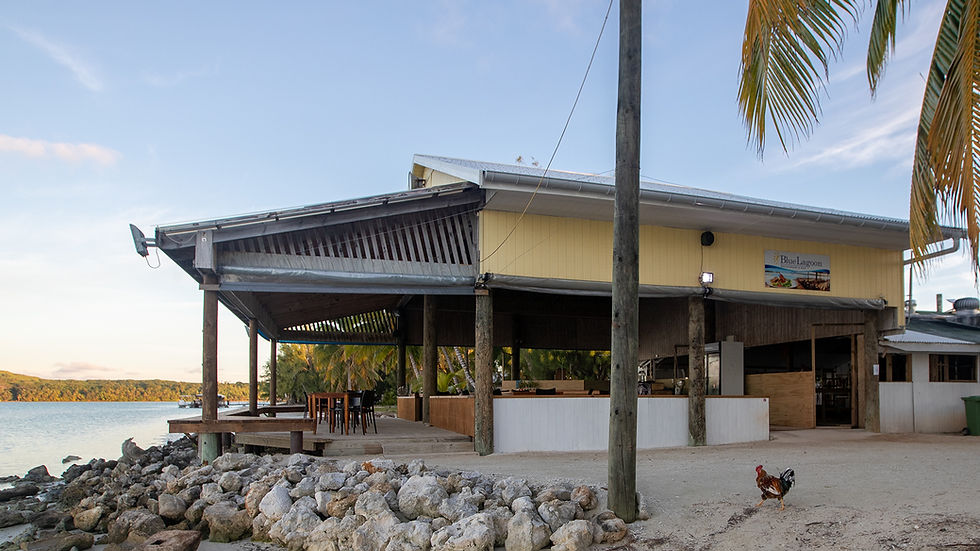
Later that night, we dine under the ironwoods. Lights twinkle from the branches, reflecting in the calm lagoon. The pop-up restaurant sets up shop with a temporary wood fire kitchen, offering three meals: NZ Rib Eye Steak with rice and local salad, Fresh Yellowfin Tuna with local veggies, and Roasted Chicken with Fries and Local Salad—all looking delicious. And everything is prepared gluten-free. I’m in heaven. We sit with another guest, a wealthy man—or so he claims—at an assigned table, kind of like on a cruise ship. We listen to him brag about his business successes and his many gifts to the world while we enjoy our beautiful meal in relative silence. We say a quick goodnight and return to our villa, where we sleep in silence for ten hours straight.

On Aitutaki, we recommend middle-of-the-road accommodations with a 3-star rating. At the time of publishing, the room rate for AT Village was $230 per night, including breakfast. And it was well worth it! Other resorts, like the Aitutaki Seaside, at $175 per night just south of the airport, offered three bungalows on a white beach with self-contained accommodations.


Comments